
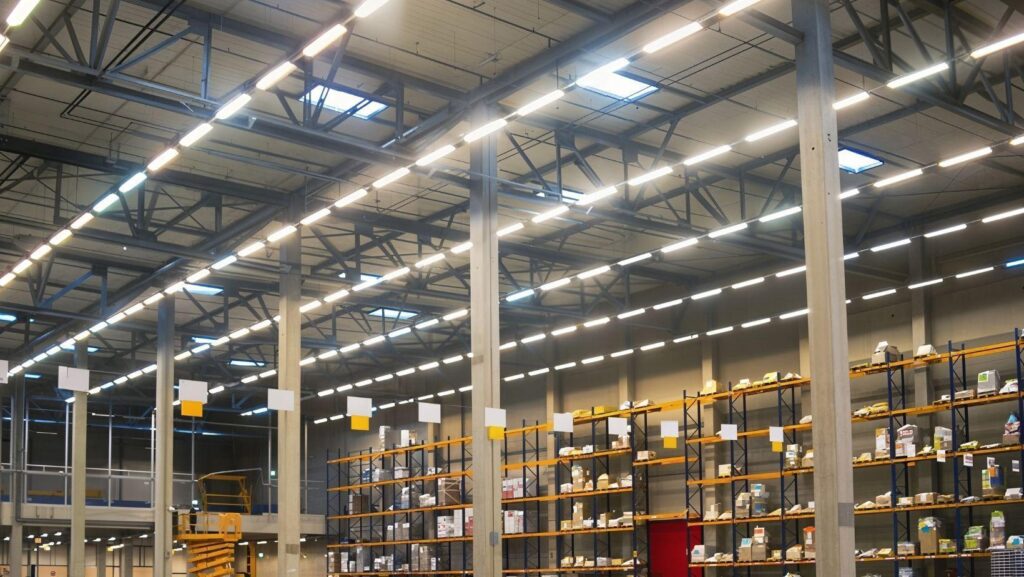
In high-velocity fulfillment, accuracy and speed are won or lost at the aisle face. While WMS rules, slotting, and robotics draw attention, light levels and distribution quietly shape scan success, label legibility, and travel rhythm. This guide lays out how purpose-built warehouse lighting moves key metrics—pick accuracy, lines per labor hour, and error-driven returns—without forcing process overhauls.
Why Lighting Strategy Matters to Picking Performance
Picking is a visual task under time pressure. Operators match SKUs to locations, scan barcodes, confirm quantities, and move. If light levels vary across bay faces, labels wash out, shadows hide digits, and scanners misread. That slows confirmation, invites workarounds, and adds rework minutes that compound across shifts.
Good lighting in a warehouse is not just “bright.” It must deliver uniform light to the vertical plane where labels and barcodes live, control glare at common viewing angles, and maintain consistency across shifts. Done right, it cuts misreads and rescans, reduces eye strain over long paths, and supports safer forklift travel at end‑of‑aisle turns.
Common Picking Errors Tied to Poor Lighting
Errors often blamed on training or slotting are frequently visual problems in disguise. Typical patterns include:
- Wrong‑location picks from shadowed bay labels that look similar two levels up.
- Rescans or manual overrides when glossy packaging throws specular glare back at handhelds.
- Quantity miscounts in dim mezzanine zones where bin interiors are dark.
- Slower confirm times in narrow aisles as operators reposition to find a readable angle.
These show up as longer cycle times in specific zones, higher exception codes on the same travel paths, or bursty mispicks after bulb outages or fixture drift.
Vertical Light in High Racks: Designing for Label Readability
Most warehouse layouts aim to meet a horizontal target at the floor, yet picking depends on vertical light at the rack face from floor to top beam. Two concepts matter:
Vertical illuminance: The light reaching labels, barcodes, and faces of cartons. Narrow-aisle work demands consistent vertical levels on both sides of the aisle so operators don’t fight contrast changes every few steps.
Uniformity: The ratio between the brightest and dimmest spots across the label plane. Large swings force the eye to adapt, which slows scan cadence.
Upgrading to LED high bay lights in narrow-aisle zones improves vertical visibility so scanners and labels are easier to read. Look for optics that shape beams toward the rack face rather than spilling light into the top volume above travel paths. In high-bay environments, spacing and mounting height drive outcomes: tighter spacing with aisle‑focused optics typically yields better uniformity on labels two to four levels up.
Practical tip: Measure vertical light at common label heights (waist, chest, eye level, and one level above). Capture both sides of the aisle at several points along the run. Plot the readings against scan success rates from your WMS to confirm the link between light uniformity and read performance.
Glare Control and Visual Comfort for Scanners and Operators
Even with sufficient light, poor glare control can wreck scan rates. Handhelds and wearable scanners see what operators see:
Veiling reflections from glossy wraps and shrink film bounce straight into eyes and sensors. High-contrast hot spots push auto-exposure routines in scanners to extremes, raising misread risk. Unshielded high-output fixtures placed directly in the line of sight force head tilts and step‑backs that add seconds to each confirm.
Address glare with three levers: fixture optics, mounting geometry, and surface considerations. Aim beams to the label plane rather than straight down; use diffusers or lenses designed to cut peak candela at common viewing angles; and set rows to avoid direct sightlines from typical pick positions. Where packaging drives persistent reflections, small task lights at problematic bays or matte label overlays can stabilize scans without touching process flow.
Sensor-Based Zones and Controls Without Slowing the Line
Occupancy and daylight controls slash runtime in low-traffic periods, but aggressive timeouts can frustrate operators. The objective is to save energy while keeping the aisle ready for motion and scanning.
Zone sensors by functional area—receiving, active pick modules, cross‑aisles, and mezzanines—and tune response times to task needs. In fast-pick zones, pair high-sensitivity motion with short off‑delays that keep light stable as operators move between adjacent bays. Daylight harvesting is a win near dock doors and clerestories, but protect scanner reliability with minimum setpoints so vertical light at labels never dips below your tested threshold. In cold storage, choose control gear rated for low temperatures to avoid lag on restart.
A Practical Framework to Audit, Model, and Deploy
1) Inventory and Map Dependencies
List zones by function (fast pick, case pick, reserve, cross‑dock) and record fixture types, mounting heights, spacing, and optics. Pull WMS data for each zone—scan fail rate, rescans per 1,000 picks, and time-to-confirm. Note near‑miss reports at intersections and end‑caps.
2) Measure and Model
Capture vertical light levels at labeled heights and build a quick heat map per aisle. Use a simple model to test fixture spacing and optics changes. The goal is not photometric perfection; it’s a shortlist of adjustments that increase vertical uniformity and cut glare risk where the data shows pain.
3) Pilot in a High-Impact Aisle
Pick one or two aisles with above‑average rescans. Swap optics or fixtures, adjust mounting angles, and set sensor timeouts to match travel patterns. Lock other variables for two weeks—no slotting changes—so results are attributable.
4) Validate Against Throughput and Errors
Compare pre/post scan fail rates, average confirm time, and lines per labor hour. Watch for unintended side effects, like flicker on camera-based scanners or delays from over‑tight timeouts.
5) Roll Out in Waves
Move to adjacent aisles and similar zones once results hold. Keep a standard spec for optics, mounting, and controls that purchasing can apply site‑wide with minimal variance.
Simple KPIs That Prove the Impact
A short set of metrics will show whether lighting changes pay off:
- Scan fail rate and rescans per 1,000 confirmations (by aisle).
- Lines per labor hour on target pick paths.
- Mispick rate tied to visual confusion (same‑bay, same‑SKU family).
- Near‑miss incidents at intersections and end‑caps.
Connect these to dollars with two multipliers: average handling cost per exception and cost of a mispick (repack, reship, customer service time). This turns a fixture spec into a business case that finance will understand.
30/60/90-Day Action Plan
- 30 days: Baseline vertical light in top 10 pick aisles, export WMS scan and exception data, and define threshold targets per zone. Select pilot aisles and confirm fixture availability, optics, and control gear.
- 60 days: Complete pilot installs, tune sensor timeouts, and gather two weeks of post‑change data. Document mounting details and spec settings that produced improvements.
- 90 days: Roll out to same‑profile aisles, train supervisors to spot glare issues in daily walks, and bake lighting checks into weekly safety audits. Update your site spec so future fit‑outs follow the proven template.
Conclusion
Lighting is part of the picking system, not just a utility bill. When vertical light at the rack face is consistent, glare is controlled, and sensors respect task cadence, scan success rises and exceptions fall. The outcome is straightforward: fewer mispicks, faster confirmations, steadier travel, and better lines per labor hour—changes that compound across shifts and seasons.
Build the case with your own data. Start with a focused audit, run a controlled pilot, and scale with a standard spec that purchasing and operations can repeat across sites. The result is a better path for accuracy, throughput, and worker comfort during every shift.